
The technology landscape is experiencing unprecedented acceleration, fundamentally changing how industries operate. Advancements now move at such a rapid pace that today’s cutting-edge tools can become obsolete almost overnight. This rapid evolution means that constant learning and adaptability are no longer optional for professionals seeking to sustain careers in technology-based fields.
To remain competitive, it is crucial to understand these trends and recognize which skills will be necessary for future job roles.
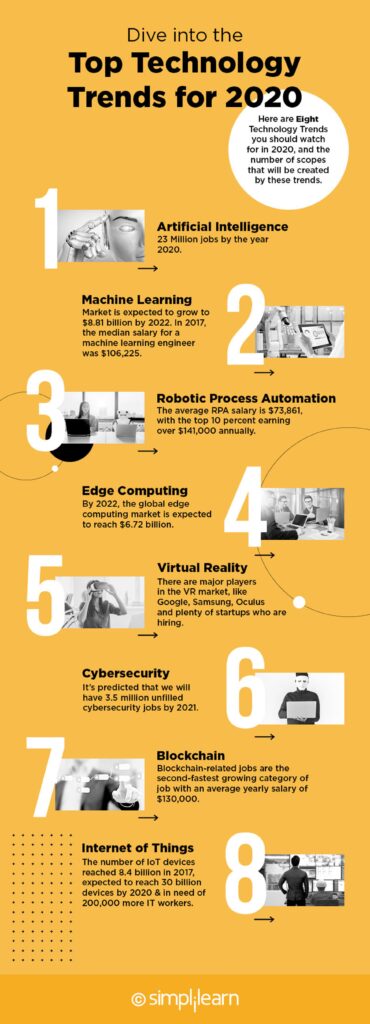
1. Artificial Intelligence (AI)
Artificial Intelligence is transforming business operations across the globe. AI refers to computer systems designed to mimic human intelligence to perform complex tasks faster and more accurately than humans, such as image recognition, speech processing, and decision-making.
Beyond consumer apps like navigation and personal assistants, AI is critical for business logistics. It is utilized to assess risks, optimize maintenance schedules, and improve energy efficiency. While automation may change the nature of work, it also creates significant demand for professionals skilled in AI development, programming, and support.
2. Machine Learning
Machine Learning, a subset of AI, enables computers to learn and adapt without being explicitly programmed for every specific task. By discovering patterns and insights from data, these systems improve their performance over time.
Applications range from enhancing web search results and real-time advertising to detecting network intrusions. For industries like logistics, machine learning powers self-driving technology and complex data analytics, creating a massive demand for skilled machine learning engineers and data scientists.
3. Robotic Process Automation (RPA)
RPA, often referred to as software robotics, utilizes software to automate routine business processes. This includes tasks such as interpreting applications, processing transactions, managing data, and replying to emails.
By automating repetitive tasks previously handled by humans, businesses can drastically increase efficiency and accuracy. Furthermore, the data churned by these systems is vital for business analytics, allowing corporations to derive better short- and long-term strategies faster than traditional analysis methods.
4. Edge Computing
While cloud computing has become mainstream, edge computing is emerging to handle specific limitations regarding data latency. Edge computing brings computation and data storage closer to the source—the “edge” of the network—to improve response times and save bandwidth.
This paradigm is essential for processing time-sensitive data in isolated areas with limited connectivity to a centralized location. As the Internet of Things (IoT) grows, edge computing serves as a mini-datacenter to handle the massive volume of data generated by connected devices.
5. Virtual Reality (VR) and Augmented Reality (AR)
Virtual Reality immerses users in a computer-generated environment, while Augmented Reality enhances the user’s actual environment. While highly popular in the gaming industry, these technologies have enormous potential in other sectors.
VR and AR are increasingly used for immersive training simulations, medical training for complex surgeries, and enhanced marketing experiences. As giant IT companies and startups venture into this market, the demand for professionals with specialized skills in VR and AR development is increasing steadily.
6. Cybersecurity
As businesses and financial institutions move more operations online, the need for robust cybersecurity has never been higher. Cybersecurity is an emerging technology that constantly evolves to defend against increasingly sophisticated hacking techniques.
The demand for cybersecurity professionals is growing significantly faster than other tech jobs. This field offers immense opportunities for experts focused on defending data integrity and securing complex IT infrastructures.
7. Blockchain
While often associated with cryptocurrency, blockchain is a powerful record-keeping technology that ensures security and trust. It is fundamentally a decentralized digital database (the “chain”) that stores information (the “block”) linearly and chronologically.
Blockchain data is secure because it can only be added to, not changed or taken away from, preventing unauthorized alterations. In addition to securing e-commerce transactions, blockchain technology is vital for validating transactions without the need for a trusted third party.
8. Internet of Things (IoT)
The Internet of Things refers to the network of physical devices, home appliances, vehicles, and other items connected to the internet that exchange data. This connectivity allows for unprecedented automation and data collection.
For businesses, IoT enables predictive maintenance, increased safety, and faster decision-making. It allows logistics companies to track assets in real-time and provides insights that enable efficiency gains that were previously unimaginable.
